
This article was originally published in French in the Guide pour un musée féministe, a project by the association musé.e.s (June 2022). English translation.
The Maison Poincaré is a new exhibition and exchange space dedicated to mathematics. Sylvie Benzoni-Gavage is a mathematician and director of the Institut Henri Poincaré, which leads the project. Céline Nadal, founder of MuseoScience, is the exhibition developer for the Maison Poincaré's permanent exhibition. Their article shows how, in a predominantly male field, the museum team chose to create an exhibition with balanced gender representation.
1. Mathematics — it is not just for men!
The proportion of women in the university mathematics community has been stable for decades: around 20%. The proportion of young women choosing to study mathematics-intensive subjects also remains unusually low.
Yet girls and boys have the same kind of brain and follow the same compulsory school curriculum, at least in France. It is at the moment of choosing study paths that the weight of stereotypes built up since primary school plays a disproportionate role.
The clichéd stereotype that girls are weaker at maths than boys proves remarkably persistent. Studies show that the very fear of confirming this stereotype prevents girls from performing well in mathematical tasks of which they are perfectly capable (1).
The result is visible in the workplace: the professions of mathematics and related fields are heavily male-dominated, and thus prone to perpetuating sexist prejudices.
Rebalancing the situation means enabling all women who wish to pursue mathematics careers to flourish in them. It also means enriching these professions with diverse perspectives: building the world of tomorrow without depriving ourselves of half of humanity. To achieve this, the problem must be tackled at its roots. Challenging prejudices and showing that mathematics is accessible to everyone. That is the ambition of the Maison Poincaré.
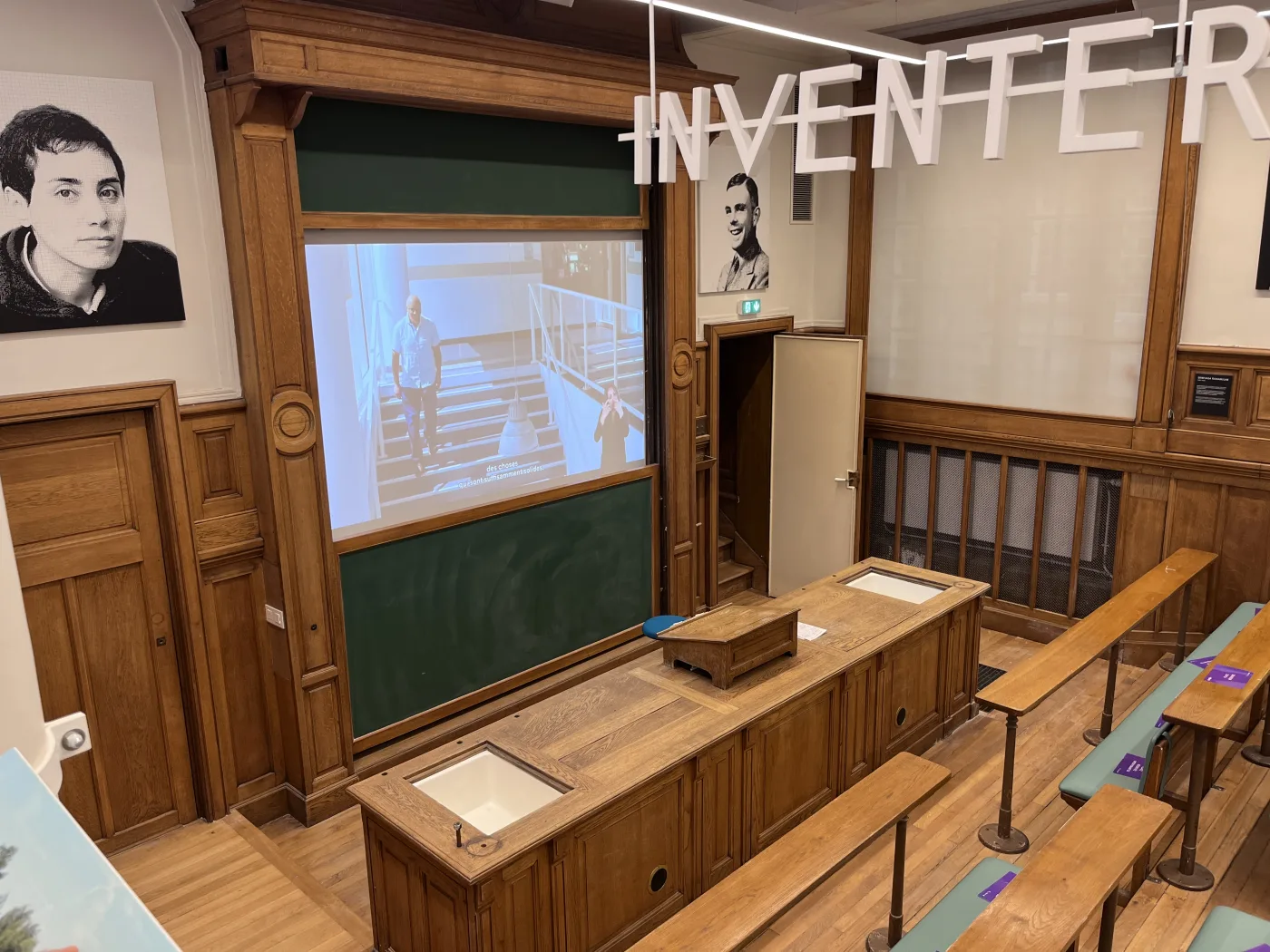 Maison Poincaré, Paris, 2023. © MuseoScience
2. The Maison Poincaré project: a committed approach
The Maison Poincaré opened in 2022–2023 in the heart of Paris as a permanent exhibition space dedicated to mathematics, with the aim of showing that it constitutes a vast, living and universal science, in permanent interaction with other sciences and with society. Although it is an overwhelmingly male-dominated field, we chose a balanced representation of women and men, as an aspiration towards what the mathematical world should be.
We also wanted to compensate for the fact that the history of mathematics has largely retained only men. Some women were deliberately overlooked by their collaborators: this is the “Matilda effect” (2). Moreover, the rare women mathematicians who have come down to posterity were even more exceptional than their male counterparts. The obstacles to be overcome were considerably greater, women having had access to the same studies and the same circles as men for barely half a century (3). This is part of the message we wish to convey.
Our vision is part of a broader commitment to inclusion. We also developed the project towards greater accessibility for people with disabilities, both motor and sensory. We want to share mathematics with everyone by taking into account the specific needs of each individual.
The team leading the project has been substantially renewed and feminised since its launch, and this fact is not unrelated to its feminist evolution:
- Sylvie Benzoni-Gavage, mathematician, has been director of the Institut Henri Poincaré since early 2018. She succeeded Cédric Villani, who had initiated the project back in 2014 with his deputy director Jean-Philippe Uzan.
- Clotilde Fermanian Kammerer, mathematician, has been an adviser to the project since 2018 and president of the Mathematical Culture Committee of the Institut Henri Poincaré since 2020, succeeding Olivier Druet.
- Marion Liewig joined in 2016 as CNRS project manager. Since January 2022, Élodie Cheyrou, CNRS research engineer, has taken over as head of the Maison Poincaré.
- Céline Nadal (MuseoScience) has been exhibition developer on the project since mid-2018.
The arrival of Sylvie Benzoni-Gavage in 2018 marked a turning point, with a determination to give the project a new, more committed direction.
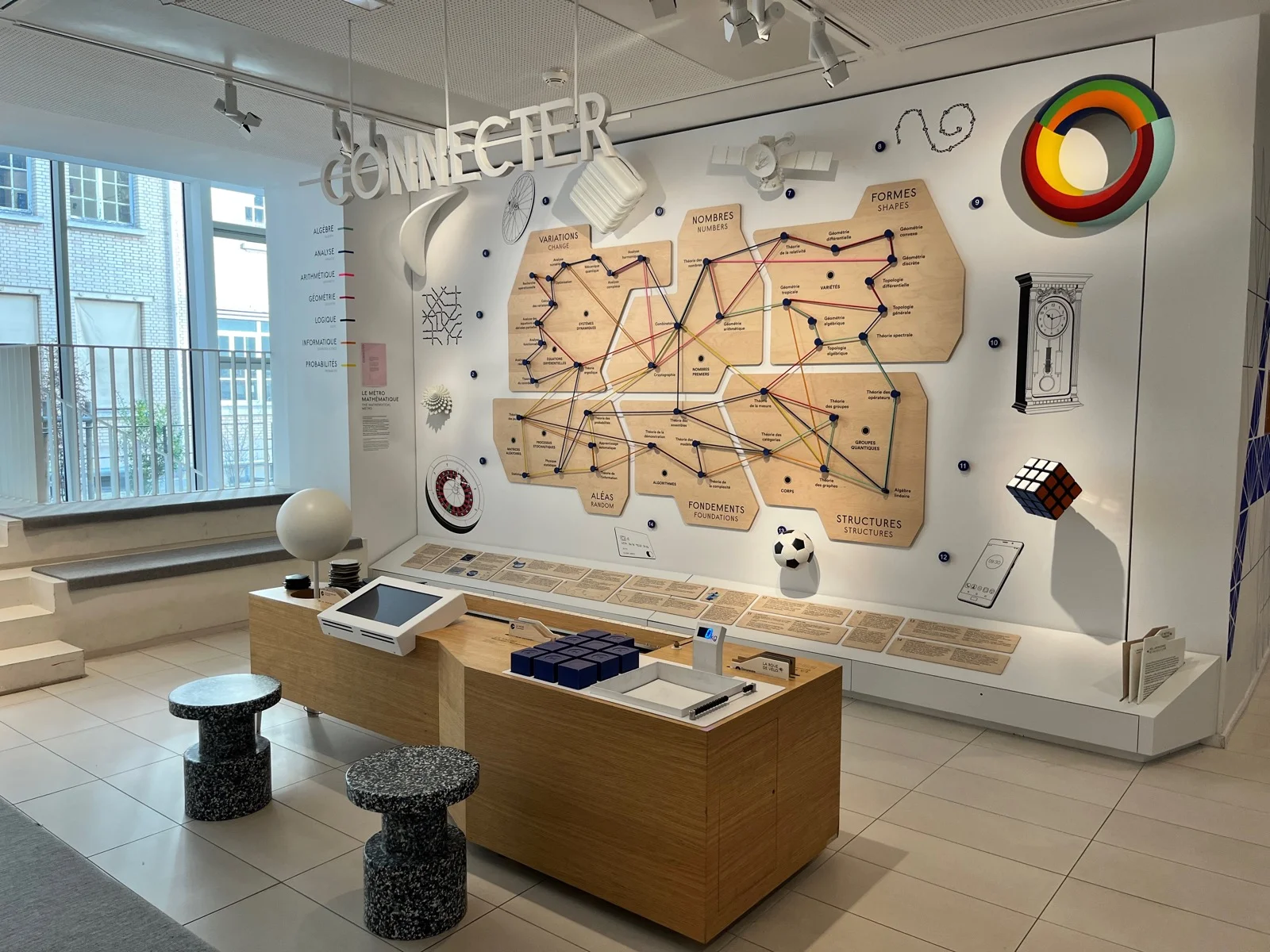 Permanent exhibition, Maison Poincaré, Paris, 2023. © MuseoScience
3. How to take concrete action at the scale of a museum project?
A gallery of intimidating portraits of the institution's founding fathers: that is what the entrance hall of the Maison Poincaré could have looked like. With the group working on this space, we quickly became aware of the problem. The first faces of the house of mathematics would have been those of middle-aged white men. Under the guise of telling the story of the place, we would have contributed to reinforcing the prejudice that women have no place in mathematics.
The feminist commitment gradually imposed itself on us. It became a priority. We made a clear choice: that of parity. We endeavoured to present as many portraits of women as of men throughout the visitor route — whether video, audio or photographic portraits, historical or contemporary figures. For example, the audio book “Let me tell you a story” recounts everyday stories from the life of a researcher: these narratives were collected from as many women as men. Even when it came to filming hands without showing faces, in a poetic video evoking the writing and invention of mathematics, we chose as many women as men.
We extended this objective of parity to the choice of narrative voiceovers, actors and fictional characters for all the films and audio and audiovisual installations in the visitor route. It was important not to fall into the ingrained sexist biases that favour male voices and give them the position of the “expert” narrator.
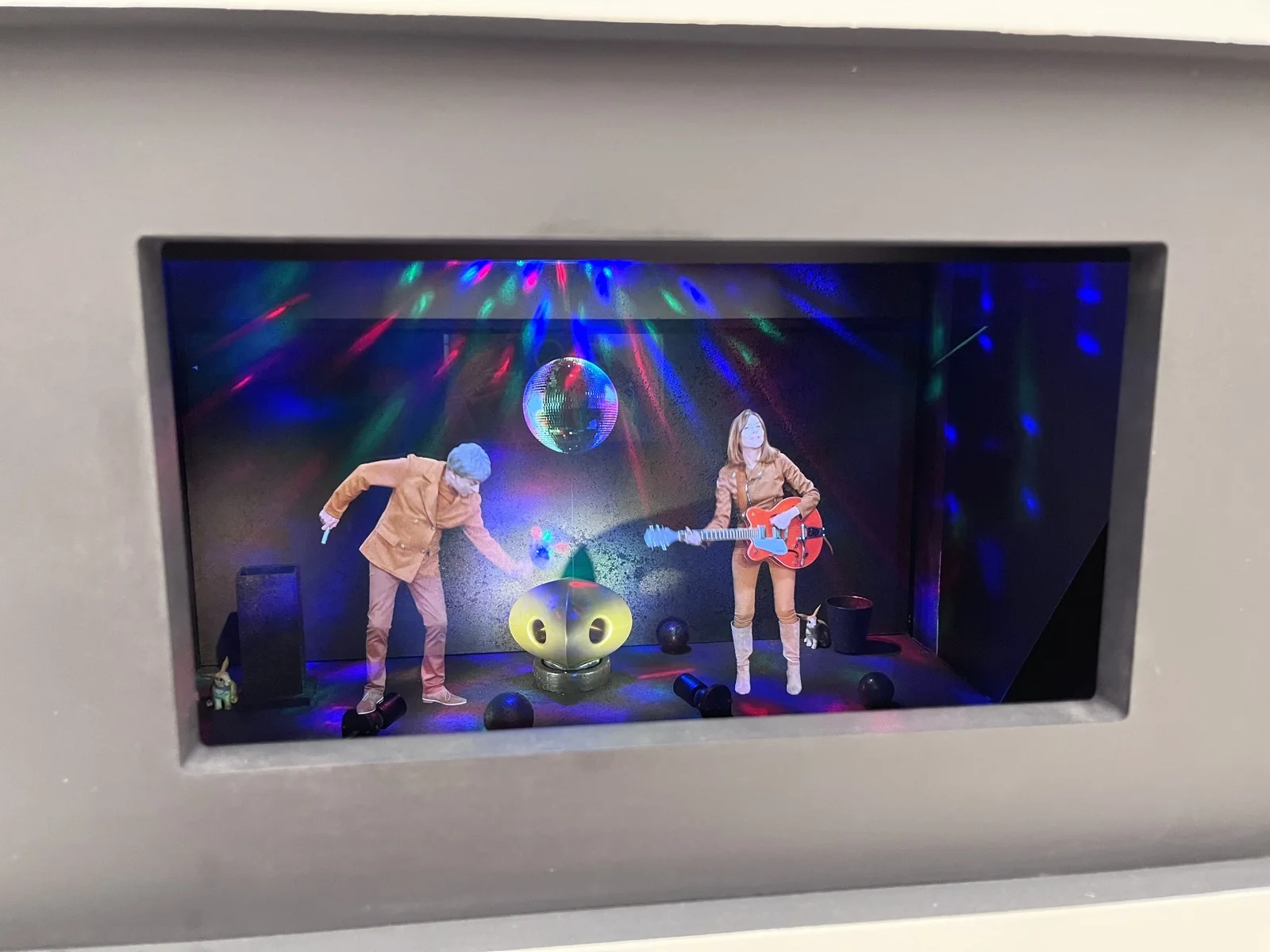 Optical theatre (Pierrick Sorin), Maison Poincaré, Paris, 2023
4. How do you fight obstacles and preconceived ideas?
Parity, against all odds: this is a principle we explained and reaffirmed at every stage of the project. It was not always easy. Here are two examples.
a. Fighting the historical erasure of women
If we rejected the idea of a gallery of founding fathers, we did not give up on telling the story of the place. The building is the former physical chemistry laboratory founded by Jean Perrin (1870–1942). In echo of Jean Perrin, we wanted to highlight a physicist, Yvette Cauchois (1908–1999), who directed the laboratory for many years after Jean Perrin and made major contributions to physics.
The exhibition designer Rémi Dumas proposed printing the portraits of Cauchois and Perrin at full scale on the wall. But to do this, images of sufficient quality were still needed. No problem for Jean Perrin. For Yvette Cauchois, this proved much more difficult. But we did not want to give up on parity. So we searched. With the help of Henri Duvillard, librarian at the IHP, we conducted a genuine investigation over several weeks, reaching out to former colleagues of Yvette Cauchois, libraries and laboratories in Paris, the United States and Romania. Gradually, we found what we were looking for. We were even able to recover several photographs of her and produce good-quality scans.
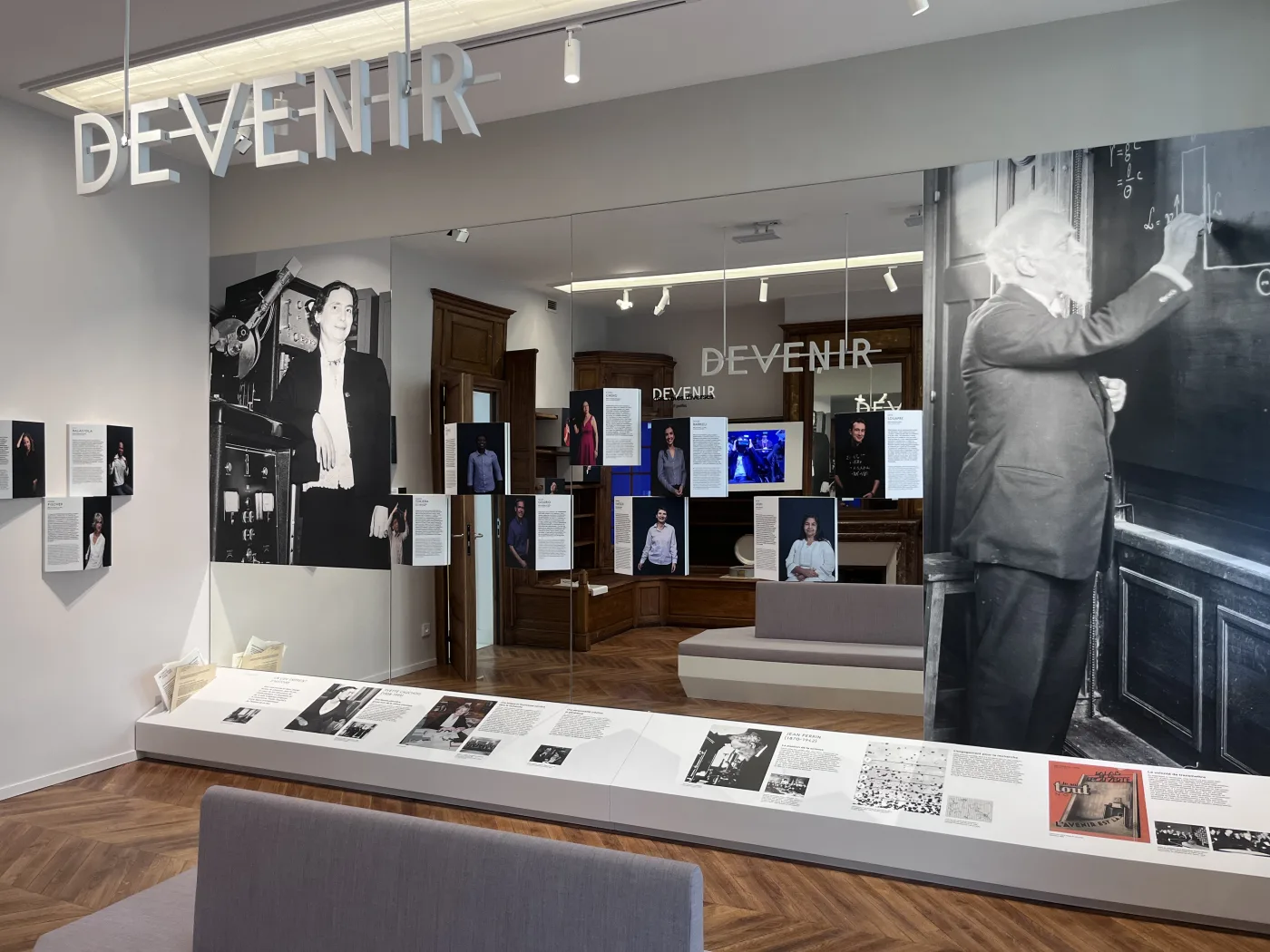 Maison Poincaré, Paris, 2023. © MuseoScience
b. Standing firm against criticism and sexist preconceptions
The “Becoming” space of the Maison Poincaré presents portraits of women and men mathematicians, to illustrate a diversity of life paths. Like the entire permanent exhibition, this space was designed with scientists. The selection of these 16 portraits prompted heated debate.
Several people, including some women, argued that there were not enough women mathematicians to achieve a balanced representation. According to them, the women mathematicians chosen to respect parity would therefore necessarily be of a lower calibre than the male mathematicians presented, and this would reinforce the prejudice that women are less gifted at mathematics.
This reasoning is flawed, as it overlooks several crucial points that we put to these critics.
First, it was simply a matter of proposing a selection of 8 women and 8 men. Even if there are globally fewer women mathematicians, finding 8 remarkable ones from around the world is entirely feasible.
Second, the level of official recognition is not free from cultural and sexist biases. The very notion of “level” is subjective and certainly does not command consensus.
Finally, and most importantly, the Maison Poincaré addresses the general public and not the scientific community. The aim is not to create a pantheon of the “best” mathematicians in the eyes of their peers, but to share examples of life paths with which young people — both boys and girls — can identify. The challenge of selecting the 16 portraits is then very different: it is not about presenting the “strongest”, but a diversity of inspiring journeys. Parity is no longer a constraint — it becomes an asset, as it encourages us to seek out other examples, beyond those always put forward.
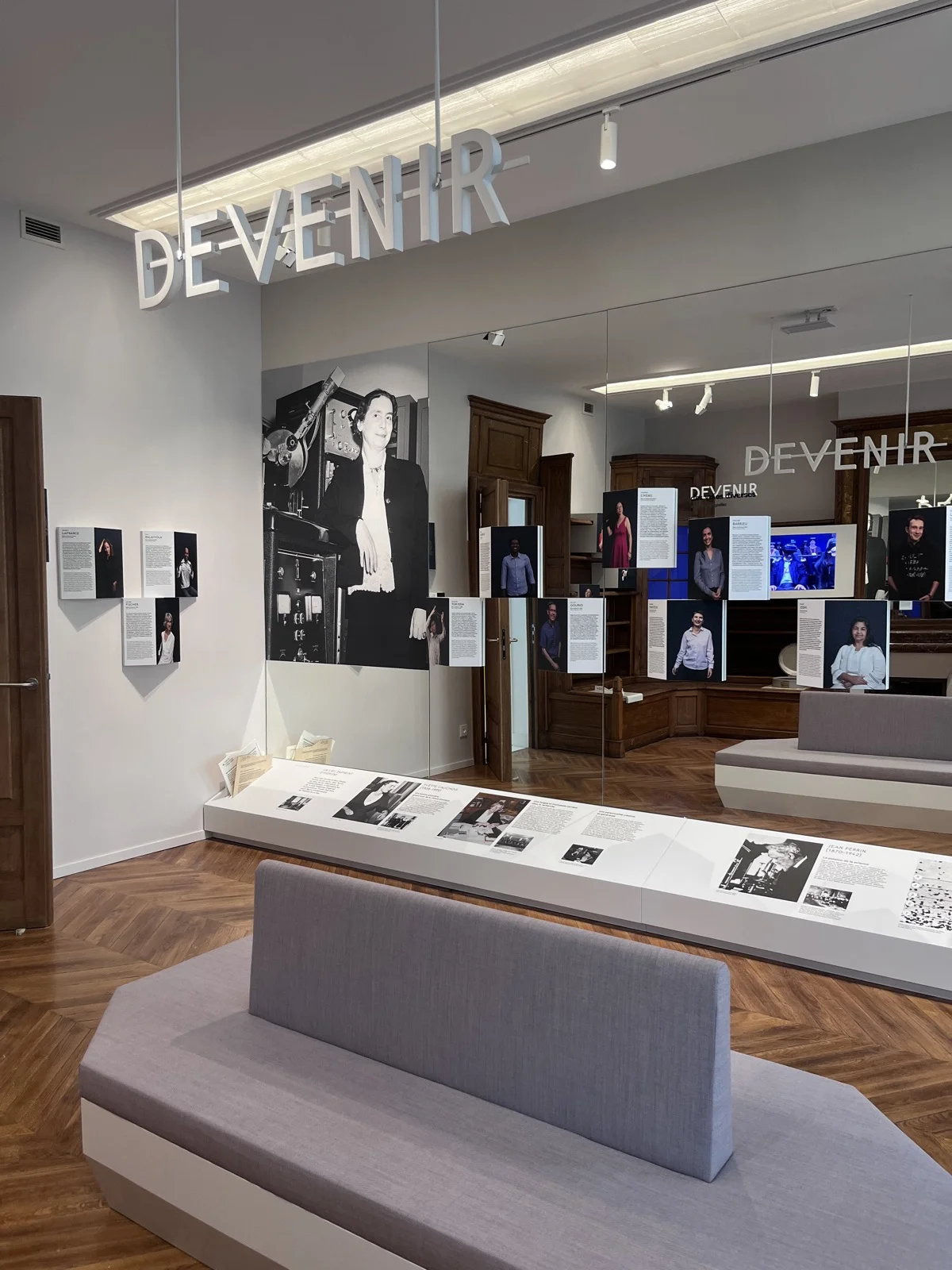 Maison Poincaré, Paris, 2023. © MuseoScience
5. Testimonials
Sylvie: “After nearly 40 years immersed in a world composed essentially of men, I have internalised many things. To the point that the entrance hall featuring the founding fathers had not shocked me at first. Four years of work later, I cannot even imagine how we could have left it that way — it was so exclusionary. My commitment to feminism has taken a great leap forward!”
Céline: “For my part, the reflection on parity for the Maison Poincaré led me to learn more about the question of gender equality and, more broadly, the sexist biases of society. It helped me to be more attentive to these in everyday life and to play a more active part in this struggle.”
A tip? Giving yourself a simple criterion — here the parity rule — helps bring greater objectivity to the debate.
(1) See the article by Pascal Huguet and Isabelle Régner, Counter-stereotypic beliefs in math do not protect school girls from stereotype threat, Journal of Experimental Social Psychology 45 (2009).
(2) The Matilda effect is observed when a scientific discovery is attributed to a man or men to the detriment of their female collaborators or other researchers.
(3) See the article by Évelyne Barbin, L'enseignement des mathématiques aux jeunes filles et les stéréotypes de genre, REPERES – IREM, no. 97, October 2014.